Smoking Regulations
Smoking Regulations in Japan: A Practical Guide for First-Time Visitors
Japan is famous for its orderliness, clean streets, and strict respect for public space. That culture of consideration extends strongly to smoking. For international visitors, especially those coming from countries with very relaxed or very strict laws, Japan’s smoking regulations can feel confusing at first. Rules differ between indoor and outdoor spaces, vary by city, and have changed significantly in the last few years.
This guide walks you through how smoking works in Japan today: where you can and cannot smoke, what to expect in restaurants and bars, how to avoid fines, and tips that help both smokers and non-smokers enjoy their trip comfortably.
How Smoking Culture in Japan Is Changing
For decades, Japan had a strong smoking culture. Cigarettes were cheap, vending machines were everywhere, and many restaurants and bars allowed indoor smoking. However, attitudes have been shifting quickly, especially around the time of major international events and with growing awareness of health and second-hand smoke.
Today you will still see many smokers, but the way and where they smoke is heavily regulated. Instead of people smoking freely on the street, smoking is concentrated in designated areas. Instead of ashtrays on every cafe table, you will more often find smoke-free dining rooms and small enclosed smoking booths.
For travelers, this means you should not assume that “no one cares” just because you see smokers around. Japan places a high value on not disturbing others, and the rules are enforced with fines in many cities.
Key Principles to Remember
Before getting into specifics, it helps to remember a few core ideas about smoking in Japan:
- Smoking is limited to designated areas in many public spaces, especially outdoors in cities.
- Indoor smoking has been heavily restricted in recent years, especially in restaurants, cafes, and public facilities.
- Local rules differ by city and ward, so what is allowed in one area might be banned in another.
- Consideration for others is essential—even where smoking is allowed, you are expected to follow etiquette.
Outdoor Smoking: Streets, Stations, and Parks
The biggest surprise for many visitors is that in some parts of Japan, you are not allowed to walk and smoke or even stand and smoke casually on the street. Instead, you must use designated smoking areas.
Designated Smoking Areas
In busy city centers such as Tokyo, Osaka, and Kyoto, you will often find outdoor smoking areas marked by signs and sometimes fenced off or partially enclosed. They are commonly located:
- Outside major train and subway stations
- Near large intersections in shopping districts
- Inside or near public parks
- On certain street corners maintained by local authorities or building owners
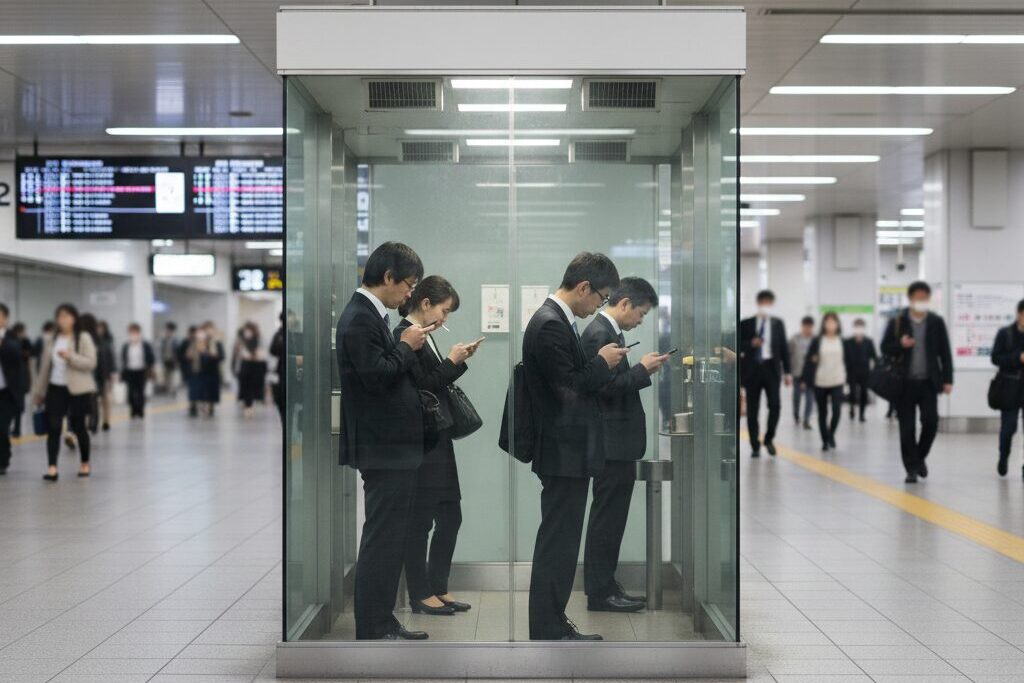
These spaces usually have large ashtrays or metal bins and clear smoking icons. Some are simple open-air zones with a sign and ashtray; others are glass-walled booths that contain smoke and reduce exposure to passersby.
Non-Smoking Streets and Sidewalk Bans
Many cities and districts in Japan have introduced sidewalk smoking bans, especially in busy areas. For example, certain wards of Tokyo and other large cities prohibit smoking on the street to prevent burns, litter, and second-hand smoke exposure.
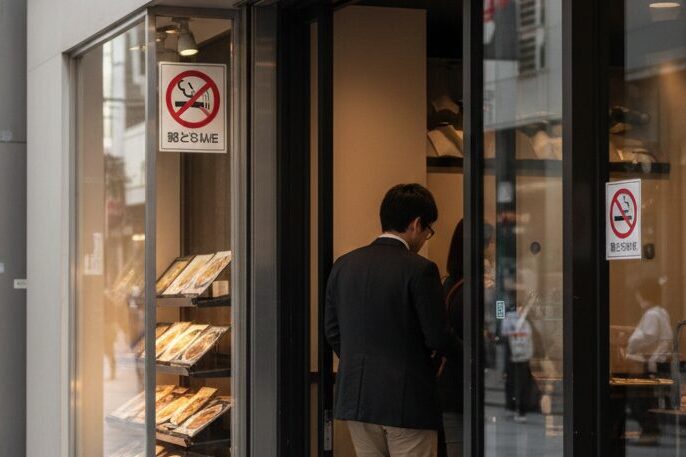
These bans are typically indicated by pavement markings or street signs showing a cigarette with a red slash and wording in Japanese and often English. If you see such signs, you must not smoke anywhere on the street—not just while walking, but even if you stop in a corner. You should locate the nearest designated smoking spot instead.
Violations can lead to on-the-spot fines. Enforcement staff in uniform occasionally patrol busy areas and may approach smokers who are breaking the rules.
Parks and Tourist Areas
In parks and major sightseeing spots, you may find a mix of rules. Some parks are entirely smoke-free; others provide a smoking area near restrooms or central facilities. Large attractions such as theme parks, museums, and temple complexes often provide clearly signed smoking zones within the grounds. Always look for signage at the entrance and on maps.
Indoor Smoking: Restaurants, Bars, and Public Facilities
Japan’s indoor smoking regulations have tightened significantly. If you visited many years ago, you may remember smoky izakaya pubs and cafes. Today, the experience is very different, especially in mainstream restaurants and public buildings.
Restaurants and Cafes
Most standard restaurants, large chain eateries, and modern cafes in cities are now completely smoke-free indoors. Many also restrict smoking on terraces or balconies, or provide a separate smoking room instead.
You may still encounter older-style venues that once had “smoking” and “non-smoking” sections. Under current rules, full indoor smoking in restaurants has been largely phased out, but some establishments have adapted by creating:
- Enclosed smoking rooms where customers can step in briefly for a cigarette between courses.
- Smoking lounges with no food service—smoking allowed, but eating and drinking are restricted inside the room.
If you are sensitive to smoke, check for signs at the entrance. Many places clearly mark themselves as “No Smoking” or indicate whether there is a designated smoking booth inside. In tourist-heavy areas, signs are often bilingual.
Bars, Izakaya, and Small Venues
Smoking regulations for smaller bars and izakaya-style pubs can be more complex. Some types of small establishments that meet certain conditions may still allow smoking in all or part of the premises, sometimes with age restrictions.
As a visitor, the easiest approach is to:
- Look at the door or window for a smoking or no-smoking symbol.
- Ask staff, “Koko wa kitsuen desu ka?” (Is this a smoking place?) or simply “Smoking OK?”
- Be prepared that some tiny, traditional bars may still be smoky, especially late at night.
If you are a smoker, remember that even when smoking is allowed, ashtrays and etiquette still apply. Do not place ashes or cigarette butts on plates or the floor, and avoid blowing smoke toward other customers.
Hotels and Accommodation
Most hotels in Japan now offer both smoking and non-smoking rooms. When booking online, you will usually see this choice clearly listed. Be sure to select the type you prefer, especially if you are sensitive to smoke—lingering odor in smoking rooms can be strong.
It is important not to smoke in a non-smoking room. Hotels may impose cleaning fees if they find evidence of smoking or strong smell in a non-smoking space. Many properties instead provide a dedicated smoking booth in the lobby or outside the entrance.
Public Buildings and Transport Facilities
Government buildings, museums, large shopping malls, and similar facilities are generally non-smoking inside. You may find a designated smoking room tucked away on one floor or in an outdoor corner. Look for a cigarette icon on facility maps or ask staff.
Train and bus stations sometimes provide indoor or outdoor smoking rooms. On large station concourses, especially in cities, these rooms are clearly marked, often glass-walled, and equipped with ventilation systems.
Smoking on Trains, Buses, and Planes
Public transport in Japan is largely smoke-free, and violations are taken seriously.
Shinkansen (Bullet Trains) and Express Trains
Many modern shinkansen and express trains are now entirely non-smoking, with no smoking seats and no smoking cars. Others have phased out smoking seats but may retain a small smoking room on board, usually located between cars.
When reserving tickets, check whether your train has smoking rooms. Even if such spaces exist, you are never allowed to smoke in your seat or in the restroom. Doing so can trigger alarms and heavy penalties.
Local Trains, Subways, and Buses
All local trains, subways, and buses in Japan are completely non-smoking, with no exceptions. Smoking is also prohibited on station platforms in many areas, except in designated smoking corners or rooms if they are provided.
Domestic and International Flights
All flights to, from, and within Japan are non-smoking. Smoking is banned not only in seats but also in aircraft toilets, with signs and announcements reminding passengers. Tampering with or disabling smoke detectors in airplane lavatories is a serious offense.
E-Cigarettes and Heated Tobacco Devices
Japan has a large market for heated tobacco devices such as IQOS and other brands. You will see their advertisements and special lounges in some cities. However, from a regulatory point of view, you should assume that:
- E-cigarettes and heated tobacco are treated similarly to normal cigarettes in most public and commercial spaces.
- Where smoking is banned, using these devices is also generally not allowed.
Designated smoking rooms may sometimes allow heated tobacco but not traditional cigarettes, or vice versa, depending on the venue. Check signs carefully and follow staff instructions.
Buying Cigarettes in Japan
Cigarettes are widely available, though rules about sales and age verification are strict.
Convenience Stores and Supermarkets
Convenience stores such as 7-Eleven, Lawson, and FamilyMart sell cigarettes behind the counter. You simply tell the staff the brand or point to the number on the display. If you look young, be prepared to show ID, as the legal age for smoking in Japan is 20.
Vending Machines
Japan is famous for its vending machines, and you may still see cigarette vending machines, particularly outside tobacco shops or in entertainment districts. However, these machines usually require a special age-verification card, which visitors do not have. As a tourist, it is easier to buy cigarettes at a staffed shop or convenience store where your passport can be used as proof of age if necessary.
Smoking Etiquette: Unwritten Rules That Matter
Beyond legal regulations, Japan has strong informal expectations around smoking behavior. Following these will help you blend in and avoid upsetting locals.
- Do not litter cigarette butts. Always use an ashtray. Carry a portable ashtray if you are a frequent smoker.
- Avoid walking while smoking. Even in places where it may not be formally banned, it is seen as inconsiderate.
- Be aware of wind and crowds. Try not to blow smoke toward others, especially children or people waiting in line.
- Ask before smoking near others. If you are outside and unsure, a simple, “Is it OK to smoke here?” to nearby people or staff goes a long way.
Following local etiquette is part of the travel experience. In Japan, respect and consideration are valued as much as following the letter of the law.
For Non-Smokers: How to Minimize Exposure
If you are sensitive to smoke or traveling with children, you can still enjoy Japan comfortably with a few simple strategies:
- Choose non-smoking accommodation and confirm your room type at check-in.
- Look for “No Smoking” labels when selecting restaurants and cafes, especially in older neighborhoods.
- Avoid standing directly next to smoking booths at stations or outside buildings; smoke can drift when doors open.
- Check train information when reserving shinkansen seats and choose cars far from any on-board smoking room, if present.
Practical Tips for Travelers
To make navigating Japan’s smoking regulations smoother, keep these points in mind:
- Look for signs first. Train yourself to scan for smoking-related icons at stations, in shopping areas, and at entrances.
- Plan smoking breaks. If you are a smoker, allow time to find a smoking area, especially before long train rides or sightseeing visits.
- Carry ID. If buying cigarettes, especially at night or in quieter areas, you may be asked to prove you are over 20.
- When in doubt, ask. Staff and locals are generally helpful and used to foreign visitors—simple gestures and a few English words usually work.
Respecting Local Rules for a Better Trip
Japan’s smoking regulations reflect a balance: the country accommodates smokers with dedicated spaces while working to protect non-smokers and maintain clean, pleasant public environments. For international visitors, understanding and respecting these rules makes travel smoother—and is also a meaningful way to participate in Japan’s culture of consideration.
Whether you smoke or avoid smoke entirely, a bit of advance knowledge helps you move confidently through train stations, restaurant districts, and tourist sites. Use designated areas, follow signs, and pay attention to the people around you, and you will find that Japan remains not only orderly but also welcoming and comfortable for everyone.
List of articles
Public Behavior & Etiquette
Basic manners in public spaces to avoid trouble.
2025年07月14日
Transportation Etiquette
Important rules for using trains and buses politely.
2025年07月14日

Onsen & Religious Site Etiquette
Key rules to follow when enjoying a Japanese onsen.
2025年07月14日
Dining & Food Etiquette
Understanding Japan’s unique noodle-eating custom.
2025年07月14日
Public Behavior & Etiquette
Places where photography is limited or not allowed.
2025年07月14日
Transportation Etiquette
Rules for smoking areas and city restrictions.
2025年07月14日
Public Behavior & Etiquette
Keeping noise low to respect quiet environments.
2025年07月14日
Public Behavior & Etiquette
Sorting trash and following local waste rules.
2025年07月14日